If you have ever typed “Serengeti migration best month” into Google, you are not alone. The Great Migration is not one single moment – it is a moving year-round cycle of grass, rain, calves, predators, and river crossings. The best month depends on what you want to see.
This guide breaks the migration into seasons you can actually plan around, with a clear month-by-month overview. For the full safari planning framework, see our Tanzania safari tours guide.
Quick Answer: What is the Best Month?
There is no single best month. For dramatic river crossings, aim for July to September in the north. For calving and predator action, January to February in the south can be incredible. For fewer crowds and green scenery, consider November or March.
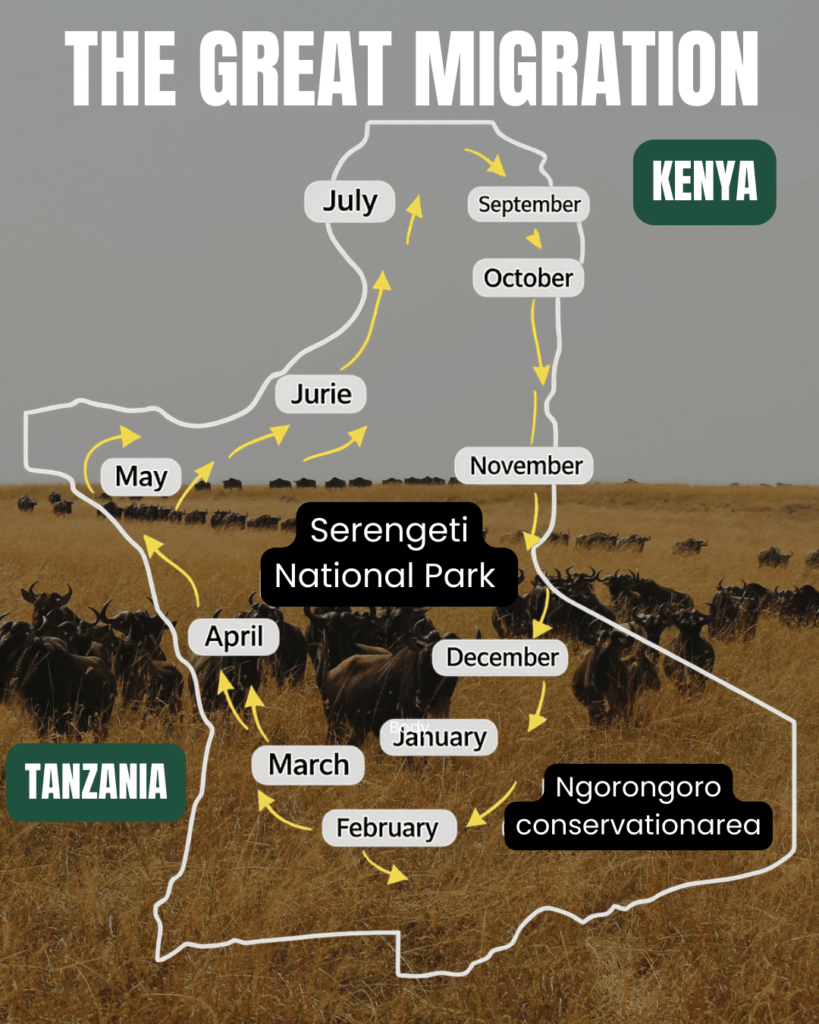
Migration Month by Month (Simple Guide)
| Months | Where | What you might see |
|---|---|---|
| Jan – Feb | Southern Serengeti (Ndutu area) | Calving season, big cat activity |
| Mar | Southern to Central | Herds begin moving, green season photos |
| Apr – May | Central / Western corridor | Long rains, fewer vehicles, some camps close |
| Jun | Western corridor | Early crossings, building momentum |
| Jul – Sep | Northern Serengeti | River crossings, peak demand |
| Oct | Northern to Central | Herds drift back, still strong wildlife |
| Nov – Dec | Central to South | Short rains, fresh grass, good value windows |
River Crossings: What They Are Really Like
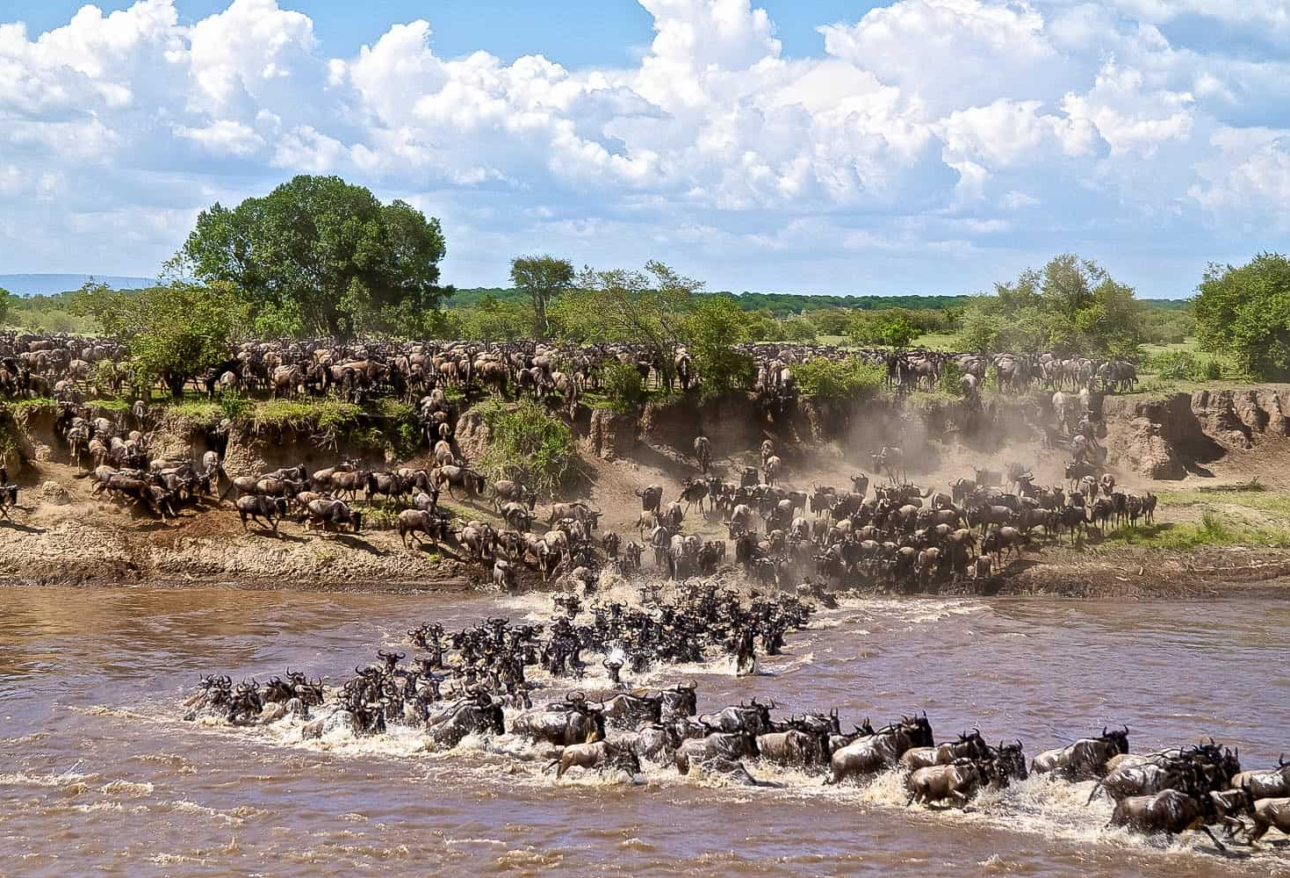
Crossings are not scheduled. You can wait for hours, then suddenly everything happens in ten minutes. Guides watch tracks, wind, and herd movement. The right camp location matters more than luck. If crossings are your priority, budget for a northern Serengeti base in peak season.
Calving Season: The Underrated Highlight
January and February in the south can feel like a nature documentary: calves, cheetahs, hyenas, and lion prides working the plains. Many travelers who do calving season say it was the most intense wildlife viewing of their lives.
How Weather Changes the Experience
Rain affects road conditions and where herds concentrate. Dry months make driving easy and visibility high. Green months bring dramatic skies and fewer crowds. Neither is “wrong” – it depends on your comfort level and photography style.
How to Choose the Right Camp Location
- If your goal is crossings – stay in northern Serengeti (Kogatende area).
- If your goal is calving – stay in the south (Ndutu and southern plains).
- If you want a general safari with migration chances – central Serengeti is flexible.
A Sample 7 Day Migration-Focused Plan
A one-week trip can still be migration-focused if you match your base to the season. For a proven Northern Circuit flow, see our 7 Day itinerary and adjust Serengeti days based on your chosen migration window.
What I Loved Most About Migration Season
The scale. You hear hooves before you see them, then the horizon starts moving. Even without a crossing, watching thousands of animals shift as one is a memory that sticks.
My Honest Experience
If you only have one chance in your life, choose a season based on your dream sighting and accept that nature is not a stage show. The “best” migration month is the one that matches your priorities and your tolerance for crowds.
Extra Planning Notes (For First-Timers)
If you are booking your first Tanzania itinerary, focus on pacing. A good safari day starts early, so protect your sleep. On beach extensions, protect your recovery time by avoiding back-to-back transfers. Ask your operator to show the exact day-by-day route, not just park names.
If you are comparing operators, look for clear inclusions, transparent fees, and realistic drive times. In Tanzania, a calm itinerary usually beats an overstuffed one.
For more context and internal links, browse our safari planning pillar and all trips.
What Most People Mean When They Say “Migration”
Some travelers imagine one single river crossing moment. Others want the moving herds and big predator density. The migration is both – but you should decide which story you want before you choose your month. The same “best month” question has different answers depending on whether you want crossings, calving, or simply herds in view.
Crossing Season Planning (July to September)
Peak months are popular because you can combine dry season visibility with the chance of crossings in the north. The trade-off is crowds and higher rates. The smartest approach is to choose a camp close to likely crossing points and to allow multiple days in the north so you do not rely on one afternoon of luck.
Calving Season Planning (January to February)
Calving season concentrates herds in the south and triggers predator behavior. It is a different style of drama than crossings but can be equally unforgettable. Camps in the Ndutu and southern plains area are often the best base for this window.
Month-by-Month Notes (More Detail)
March
Green scenery and moving herds. A good month if you prefer fewer vehicles and do not need crossings.
June
A transition month. The western corridor becomes important and you can get strong safari conditions before the absolute peak crowds arrive.
October
Herds drift and you can still have excellent wildlife without the busiest weeks.
How to Combine Migration With Ngorongoro
Migration plans often focus on Serengeti zones. Ngorongoro is a consistent wildlife bonus that works any month. A common pattern is Serengeti first for migration focus, then Ngorongoro as a finale.
If you can only add one buffer to improve your chances, add one more Serengeti night in the zone that matches your month.
For a ready-made loop, start with our 7 Day itinerary and increase Serengeti days when migration is your priority.
Detailed Notes and Practical Tips
Good safari planning is built from small details: early starts, realistic transfer days, and clear expectations. The more your itinerary respects energy levels, the more you will enjoy the wildlife moments when they happen.
When comparing options, read inclusions carefully, ask for exact lodge names, and confirm park fees and taxes in writing. A clear plan is usually a sign of a professional operator.
If you want help matching dates, lodges, and route style, use the contact page to request a custom itinerary and compare it to our trip list.
How to Plan Around Crowds and Prices
Peak months have the highest demand, especially when travelers chase river crossings. If you want that window with fewer crowds, consider late September or early October when conditions can still be strong. If you want good value, November and March can be excellent for scenery and wildlife without the same pricing pressure.
Migration Planning for First-Time Safari Travelers
If this is your first safari, do not build the entire trip around a single crossing moment. Choose a strong Serengeti base for the month, plan two full Serengeti days at minimum, and treat a crossing as a bonus. Your trip will still be incredible even without a dramatic crossing.
Serengeti Zones Explained (Simple)
| Zone | Best months | Why travelers choose it |
|---|---|---|
| Southern plains | Jan-Feb | Calving and predator action |
| Central Seronera | Year-round | Flexible access and strong general wildlife |
| Western corridor | May-Jun | Movement and early crossing possibilities |
| Northern Kogatende | Jul-Sep | Crossing season focus |
If you want the migration mapped to your exact travel week, share your dates and we can recommend the best Serengeti base. Use Contact Us or browse All Trips for routes that match your month.
Best month depends on your dream sighting: crossings, calving, or quiet green scenery.
Deep Planning Notes 1
This section exists for travelers who want to plan calmly and avoid surprises. It explains what guides do not always say in short itineraries: where time goes, what feels rushed, and which small choices change the whole mood of the trip.
What a “good day” feels like
A good safari day is simple: you start early, you see wildlife without chasing, you stop for coffee and photos, and you return with enough energy to enjoy dinner. A bad safari day is a spreadsheet: too many gates, too many hours on the road, and not enough time with animals.
Questions that reveal quality
- Which park zones do you expect to focus on, and why?
- How many hours are we realistically driving on transfer days?
- What time do game drives start and end at our specific camp?
- What is the backup plan if weather changes road conditions?
- Is the itinerary flexible, or fixed to a shared group schedule?
Simple checklist before you pay
| Check | Why it matters |
|---|---|
| Clear inclusions | So you compare quotes fairly |
| Named lodges or camps | So you can judge location and comfort |
| Realistic timing | So the trip feels like a holiday |
| Private vs shared vehicle | Big impact on comfort and photos |
| Internal flight rules (if any) | Baggage limits can change packing |
If you want a safe next step, use these internal links: Tanzania safari tours guide, All Trips, and Contact Us.
Migration planning without obsession
Plan for strong general wildlife first, then optimize your Serengeti zone for the month. If you get a crossing, it is a bonus. If you do not, you still have an excellent safari story.
Deep Planning Notes 2
This section exists for travelers who want to plan calmly and avoid surprises. It explains what guides do not always say in short itineraries: where time goes, what feels rushed, and which small choices change the whole mood of the trip.
Deep Planning Notes 3
This section exists for travelers who want to plan calmly and avoid surprises. It explains what guides do not always say in short itineraries: where time goes, what feels rushed, and which small choices change the whole mood of the trip.
How to Pick the Best Serengeti Zone for Your Month
Month matters, but camp position matters more. A well-located camp reduces daily driving and increases time with herds. If you travel in July to September, prioritize the north. If you travel in January to February, prioritize the south. Central Serengeti works year-round when you want general wildlife without chasing one event.
A Simple 3-Step Migration Planning Method
- Choose your travel month (fixed by your vacation dates).
- Choose your dream sighting (crossings, calving, or quieter scenery).
- Choose the Serengeti zone and lodge base that match those two decisions.
What to Expect If You Miss a Crossing
Even without a crossing, migration season usually delivers huge herds, predators following movement, and the feeling of being in a living ecosystem. A crossing is a bonus, not the only way the migration feels special.
How Migration Fits With a First Northern Circuit Safari
First-timers often combine Serengeti with Ngorongoro for variety. Ngorongoro is strong any month, so it stabilizes your itinerary even when migration movement changes. Start with our main safari guide and use Contact Us to match your dates to a Serengeti base.
Weather and Road Conditions by Season
Rain affects not only comfort but also which tracks are drivable. In heavy rains, some roads become slow or muddy and wildlife concentrates in different areas. In dry months, dust is the main factor and animals gather around reliable water. Your month choice should reflect how tolerant you are of rain and how important crowd levels are to you.
Migration vs General Serengeti Safari – How to Set Expectations
A migration-focused safari is about positioning. A general Serengeti safari is about variety: cats, elephants, hippos, and wide plains, regardless of herd density. If you are a first-time visitor, a strong general safari with the right zone for your month is usually the best plan.
Small actions that improve your odds
- Spend at least two full Serengeti days in your chosen zone.
- Choose a camp location that matches the month rather than a cheap distant base.
- Build one buffer day so a long transfer does not steal your best drive.
If you share your dates, we can recommend a base. Use Contact Us for a month-aligned suggestion and browse All Trips to compare routes.
What to Tell Your Operator (So They Place You Correctly)
- Your travel month and exact dates.
- Whether you prioritize crossings, calving, or fewer crowds.
- Your comfort level with bumpy roads and long drives.
- Your budget tier (mid-range vs luxury) because camp location matters.
Migration Planning for Photographers
If photography is a priority, plan for light and dust. Dry months create golden haze and dramatic sunsets. Green months create cleaner air and deeper skies. River crossings are intense but chaotic; calving season offers cleaner compositions with open plains and more predictable predator action.
A Sample 8 Day Migration-Tuned Northern Circuit
| Day | Plan | Focus |
|---|---|---|
| 1 | Arrive Arusha | Rest |
| 2 | Manyara or Tarangire | Warm-up wildlife |
| 3 | Transfer to Serengeti zone for your month | Positioning |
| 4 | Serengeti full day | Dawn and afternoon |
| 5 | Serengeti full day | Follow herd movement |
| 6 | Serengeti full day (optional extra) | Buffer for crossings or cat time |
| 7 | Ngorongoro rim | Scenic shift |
| 8 | Crater then depart | Finale |
For a shorter base route, start with 7 Day Northern Circuit safari and increase Serengeti days when migration is your main goal. For custom placement, use Contact Us.
Migration Myths That Confuse First-Timers
- Myth: you must see a crossing for the trip to be worth it. Reality: herds and predators are spectacular even without crossings.
- Myth: one camp fits all months. Reality: location should match the season.
- Myth: green season is bad. Reality: it can be quiet, scenic, and good value if you accept some rain.
If you share your month, our team can suggest a zone and camp position. Use Contact Us to request a migration-aligned plan.
Frequently Asked Questions
There is no single best month. July to September is famous for river crossings, while January to February is excellent for calving and predators.
No. Crossings depend on herd movement and conditions. Staying in the right northern area improves your chances.
Yes. February can be amazing for calving season in the south and strong predator action.
November, March, and parts of April to May can be quieter. Weather is more variable but scenery can be beautiful.
Yes, if your Serengeti base matches the season. You may not see a crossing, but you can still track herd areas with a good guide.
Northern Serengeti for crossings (July to September), southern plains for calving (Jan to Feb), and central Serengeti for general year-round access.
Both. Herds move between Serengeti (Tanzania) and Maasai Mara (Kenya) depending on season and grass.
Not necessarily. Green season can have fewer crowds and great photography, but some roads get muddy and camps may close.
Three to six months ahead is common for peak camps. Some popular locations sell out earlier in July and August.
You can have both, but migration-focused routing is about location. Big Five sightings are possible year-round with the right parks and time.
Final Thoughts
If you tell us your travel month and what you most want to see, we can suggest the right Serengeti zone and lodge base. Browse all trips or contact our Arusha team to plan a migration-aligned route.